Kirkland Lake Discoveries Hits 25.85 g/t Au over 3.00 m at Mirado Fault Zone
Toronto, Ontario--(Newsfile Corp. - September 9, 2026) - Kirkland Lake Discoveries Corp. (TSXV: KLDC) (OTCQB: KLKLF) ("KLDC" or the "Company") is pleased to report on results for an additional drill hole from the North Zone of the Mirado deposit. KLM26-030 successfully intersected multiple broad intervals of gold mineralization and high-grade gold, including 25.85 g/t Au over 3.00 m within a 7.24 g/t Au over 11.10 m interval at the Mirado Fault. This hole is part of the ongoing summer 2026 drill program at the KL South Project, 18 km south of Kirkland Lake, with 21 additional holes pending.
Highlights
- KLM26-030 hit a silica-flooded zone grading 7.24 g/t Au over 11.10 m from 353.00 m including 25.85 g/t Au over 3.00 m at the Mirado Fault beneath the historical deposit as well as multiple broad lower-grade intervals closer to surface
- KLM26-030 is the northernmost drill hole to date and has extended the stacked, steeply dipping gold mineralization of the North Zone an additional 125 m
- The Mirado Fault, previously identified in KLM26-006, which assayed 2.46 g/t Au over 14.70 m including 12.52 g/t Au over 1.80 m, was intercepted at 353 m downhole and continues to bear high-grade gold 180 m along strike
- Hole KLM26-047, situated 100 m northwest of the discovery holes at Mirado West, has intersected intense silica-chlorite alteration associated with sulphide mineralization in a structure from 369 m to 378 m downhole
- 21 holes pending results
- Eight from Mirado North and South
- Seven from Mirado West
- Six regional targets
Stefan Sklepowicz, Chief Executive Officer, commented: "Hitting 25.85 g/t gold over 3 metres at depth is exactly the type of intercept we were looking for to confirm our structural model. These high-grade feeder zones are the lifeblood of the major multi-million-ounce gold deposits in the Kirkland Lake camp. Demonstrating this high-grade continuity at Mirado drastically increases the scale and potential of our project. We now have a broad surficial expression of 1.3 km of gold mineralization and multiple high-grade zones that appear to be feeding it."
Denis Laviolette, Executive Chairman, added: "The Kirkland Lake camp has historically produced over 47 million ounces of gold, largely from deep, steeply dipping vein systems. Discovering these deep high-grade structures beneath our near-surface mineralized footprint proves that Mirado has the structural plumbing required to host a significant deposit and we're just scratching the surface."
High-Grade Structural Intercepts and Regional Geological Context
The exploration team is highly encouraged by the structural intercepts at depth, which point to a robust, high-grade orogenic gold feeder system driving the broader zones of near-surface gold mineralization. The recent drill results underscore the exceptional grade potential of these deeper, structurally controlled feeder zones across the Mirado system:
- Mirado Fault Expansion: Hole KLM26-030 successfully intersected 7.24 g/t Au over 11.10 m starting from 353 m downhole. This broad interval hosts an exceptional high-grade core, returning 25.85 g/t Au over 3.00 m
- Proven Strike Continuity: The high-grade gold mineralization within the Mirado Fault continues to bear high-grade gold 180 m along strike from where it was previously identified in hole KLM26-006, see May 25, 2026 News Release
- Deep High-Grade Gold Horizons at Mirado West: Hole KLM26-035 intersected a deeper high-grade intercept of 36.72 g/t Au over 1.01 m from 174.49 m, showcasing that the mineralized envelope continues at depth with significant grade
- Favourable Structural Alteration: Drilling at Mirado West has encountered intense alteration and mineralization outside the known footprint, detailed below in hole KLM26-047
Drill hole KLM26-030 was primarily designed to test the continuity of the Mirado Fault. While advancing toward this deep target, the Company was highly encouraged to intersect multiple uphole zones of intense silica flooding and variable sulphidation in the hanging wall. The presence of these pervasive alteration zones ahead of intersecting the Mirado Fault suggests a robust and extensive hydrothermal system, highlighting the potential for additional stacked mineralized lenses outside the primary target area.
These intercepts suggest that the Mirado deposit is underpinned by an extensive network of steeply dipping high-grade gold feeder structures. The Kirkland Lake gold camp is world-renowned for these exact types of deep, structurally controlled, high-grade gold systems. Iconic past-producing operations in the district, such as the Kerr-Addison and Lake Shore mines, as well as Agnico Eagle's active Macassa mine, all rely on deep-rooted feeder structures that often extend for kilometres beneath the surface. At Macassa, active mining occurs at depths exceeding 2.5 kilometres with grades averaging around 17 g/t Au.
Identifying a high-grade structural corridor at Mirado that exhibits similar geological characteristics strongly suggests the potential for a comparable deep-rooted system at the KL South Project. The Company interprets that current drilling is very high in this system. Mineralization hosted on adjacent and/or nearby properties is not necessarily indicative of mineralization hosted on the Company's property.
To provide visual context for these developments, the expanding footprint of the Mirado deposit, which includes 2026 drilling, gold assay composites, and historical surface sampling, is detailed in an updated plan map, see Figure 1. Furthermore, the depth extent and steeply dipping geometry of the North Zone, highlighted by the deep intercepts in KLM26-030, are illustrated in simplified long-section and cross-section views, see Figure 2.
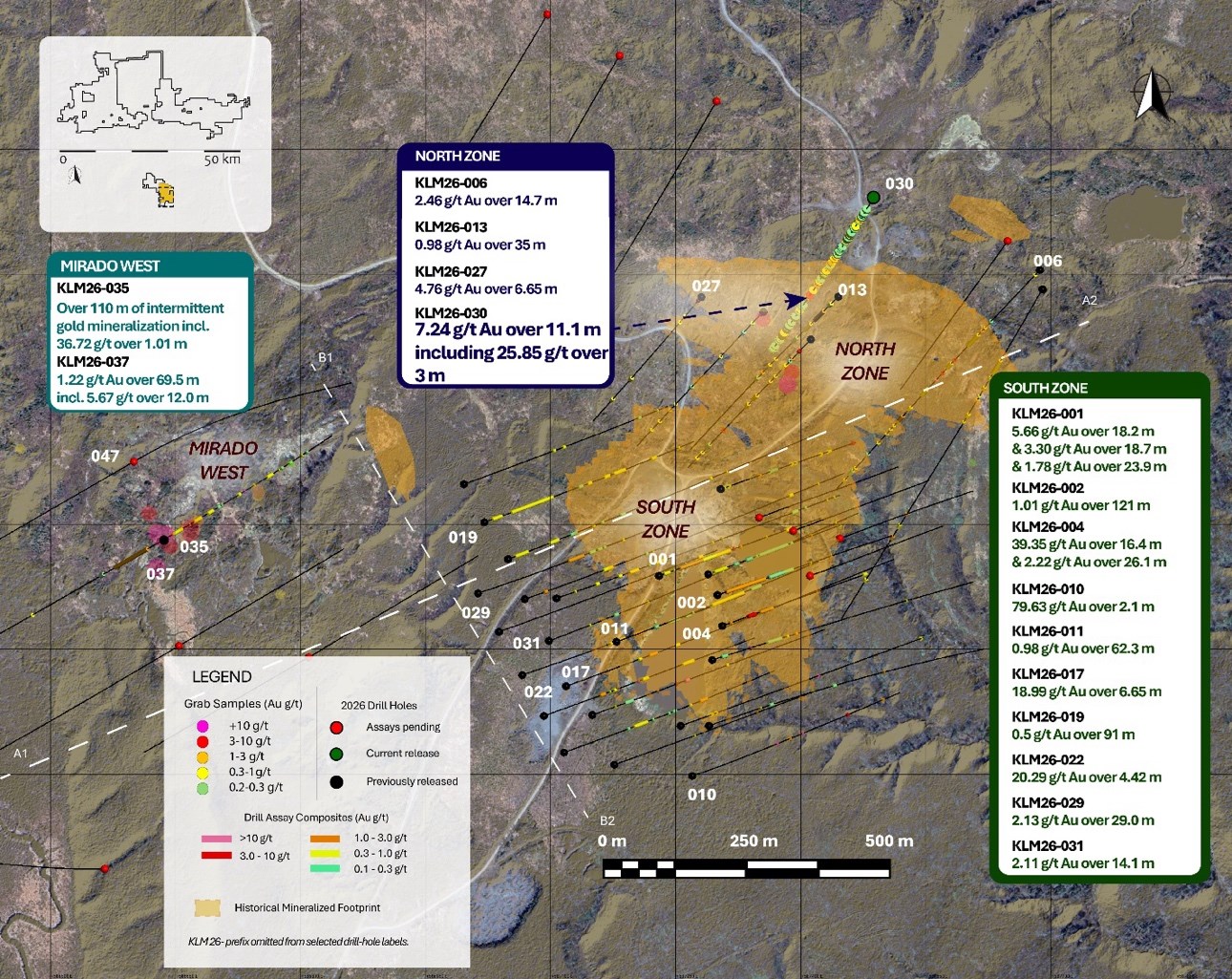
Figure 1 - Plan map of the Mirado deposit showing 2026 drilling, gold assay composites, historical surface sampling and the historical mineralized footprint.
To view an enhanced version of this graphic, please visit:
https://images.newsfilecorp.com/files/5701/313575_84713627f400eaa7_001full.jpg
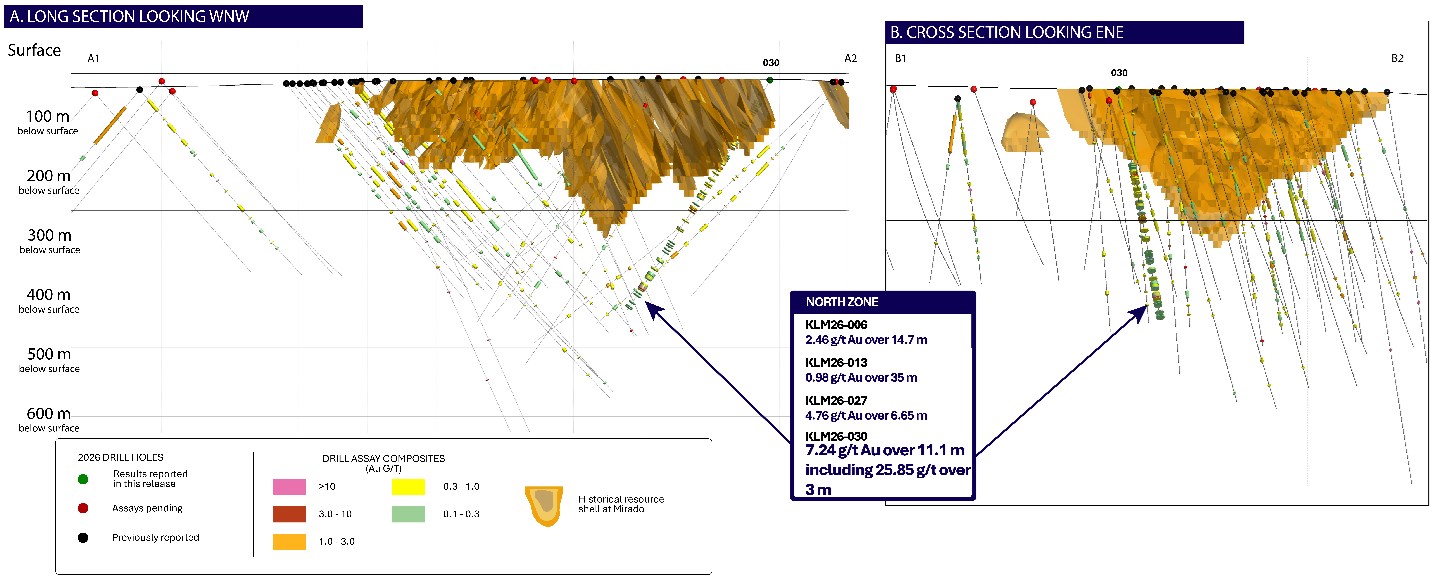
Figure 2 - Simplified long-section and cross-section views of drilling at Mirado. The historical mineralized shell is shown in orange, with current release drill holes highlighted in green and drill assay composites coloured by gold grade.
To view an enhanced version of this graphic, please visit:
https://images.newsfilecorp.com/files/5701/313575_84713627f400eaa7_002full.jpg
Exploration momentum continues at the KL South Project. The Company is currently awaiting assay results from 21 additional holes from the ongoing summer 2026 drill program. These pending holes include:
- Eight holes from Mirado North and South
- Seven holes from Mirado West
- Six holes from regional targets
A detailed breakdown of the gold assay intervals for hole KLM26-030, alongside a strip log visualizing the continuous mineralized halo and high-grade peaks, and high-resolution photography of KLM26-030 are provided below, see Table 1 and Figure 3.
Table 1 - KLM26-030 Drill Results
| Drill Hole | From (m) | To (m) | Interval (m) | Au (g/t) | Zone |
| KLM26-030 | 26.00 | 27.00 | 1.00 | 1.12 | North Zone |
| and | 37.00 | 39.00 | 2.00 | 0.25 | North Zone |
| and | 48.30 | 57.00 | 8.70 | 0.27 | North Zone |
| and | 73.10 | 74.00 | 0.90 | 0.54 | North Zone |
| and | 78.00 | 80.00 | 2.00 | 0.24 | North Zone |
| and | 92.00 | 116.00 | 24.00 | 0.44 | North Zone |
| and | 140.00 | 160.00 | 20.00 | 0.36 | North Zone |
| and | 168.75 | 171.17 | 2.42 | 0.25 | North Zone |
| and | 192.00 | 203.00 | 11.00 | 0.49 | North Zone |
| including | 197.75 | 202.30 | 4.55 | 1.02 | North Zone |
| and | 219.00 | 226.40 | 7.40 | 0.89 | North Zone |
| and | 255.45 | 259.00 | 3.55 | 1.19 | North Zone |
| and | 292.00 | 292.45 | 0.45 | 0.95 | North Zone |
| and | 353.00 | 364.10 | 11.10 | 7.24 | Mirado Fault |
| including | 359.00 | 362.00 | 3.00 | 25.85 | Mirado Fault |
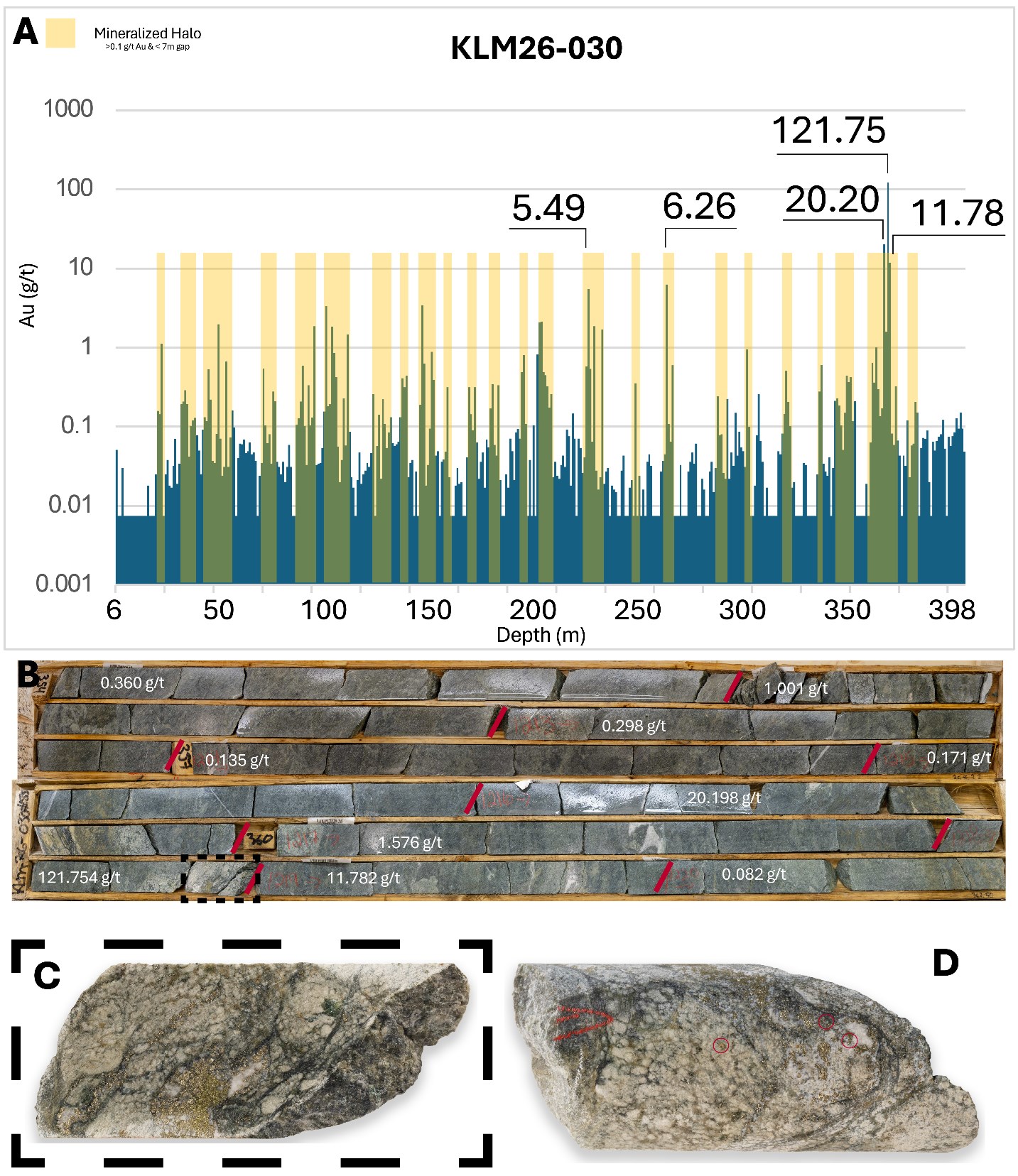
Figure 3 A - Au assays from KLM26-030. Mineralized halo highlighted where Au mineralization is above 0.1 g/t and < 7 m gap. B - High-resolution photos of KLM26-030 displaying gold grade for each sample interval. C - Macro photo of KLM26-030 at 361 m grading 121.75 g/t Au. D - Macro photo of reverse side of KLM26-030 at 361 m with visible gold circled.
To view an enhanced version of this graphic, please visit:
https://images.newsfilecorp.com/files/5701/313575_84713627f400eaa7_003full.jpg
Mirado West Visual Update
Further supporting the presence of a deep feeder system, hole KLM26-047, situated 100 m northwest of the discovery holes at Mirado West, intersected intense silica-chlorite alteration associated with sulphide mineralization in a structure from 369 m to 378 m. Visual logging of the core from this interval reveals significant structural deformation, characterized by strong chlorite flooding, distinct silica veining that overprints the host rock and disseminated, semi-massive and fracture-filled pyrite. This style of alteration is highly indicative of the deep-seated fluid pathways targeted across the property, see Figure 4. Intersecting this level of intense alteration well outside the previously known mineralized footprint further validates the exploration model and highlights the expanding prospectivity of the Mirado West area. Assay results for hole KLM26-047 remain pending. Visual observations of alteration and sulphide abundance should not be considered a proxy or substitute for laboratory analysis.
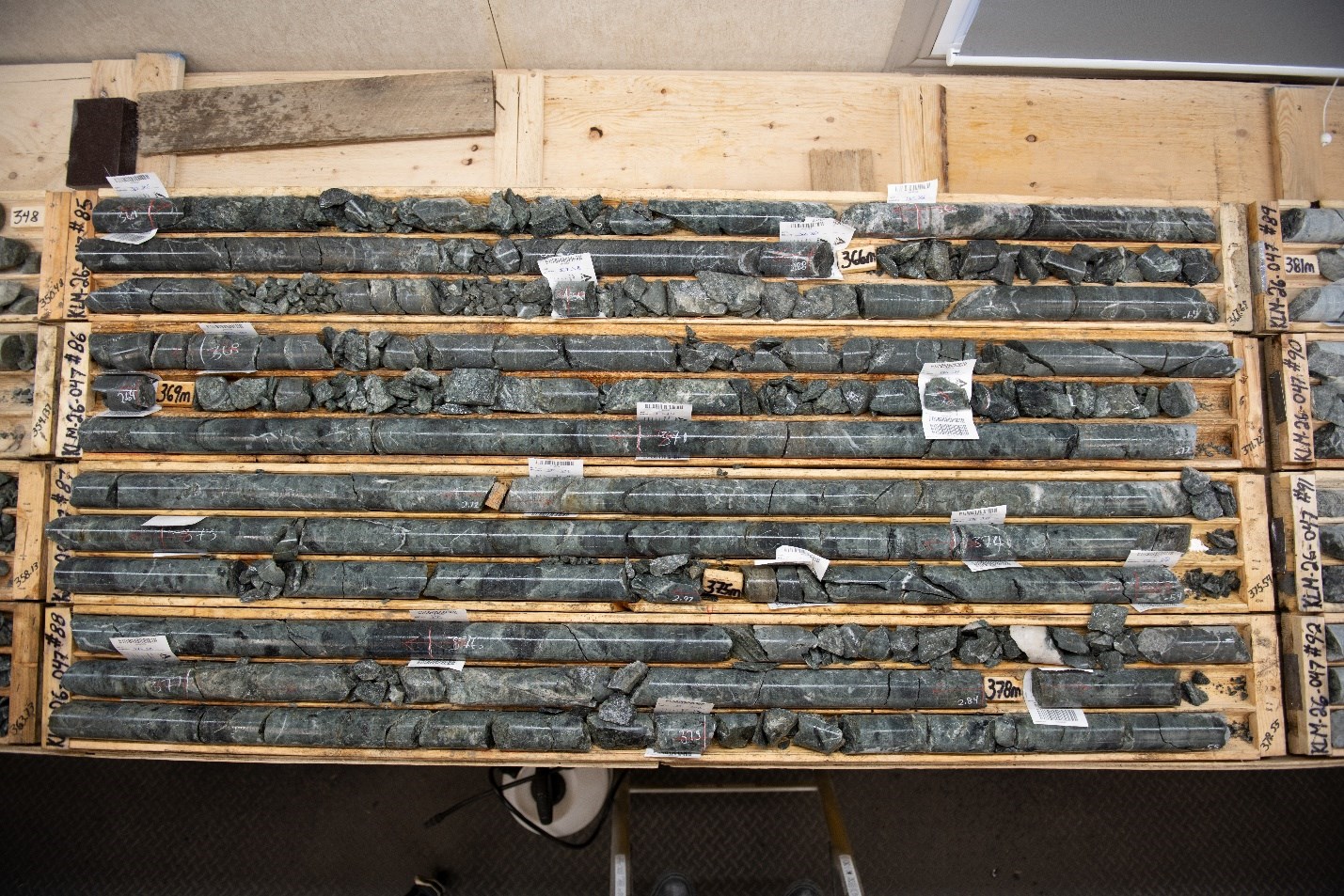
Figure 4 - Core photos of KLM26-047 from 363.73 m to 378.55 m
To view an enhanced version of this graphic, please visit:
https://images.newsfilecorp.com/files/5701/313575_84713627f400eaa7_004full.jpg
Digital Resources
Stakeholders can explore KLDC's drilling through a publicly accessible interactive 3D model hosted by Mining Hub, which illustrates drill-hole data, mineralized intervals and interpreted target areas. The latest episode of KLDC's Treasure Hunters video series also provides a review of this news release and visuals from KLM26-030 and KLM26-047.
Cannot view this video? Visit:
https://www.youtube.com/watch?v=Kyb6RyHh3Ak
Data Verification & Quality Assurance/Quality Control (QA/QC)
Gold analyses were completed on half-core NQ samples at Paragon Geochemical Laboratory (independent of KLDC) using Chrysos PhotonAssay technology. PhotonAssay is a non-destructive method that uses high-energy X-rays to measure gold in large samples of approximately 500-g samples, reducing sampling variability associated with coarse gold mineralization and allowing the retained material to remain available for additional analysis.
Table 2 - Paragon Sample Preparation and Analytical Methods
| Analysis | Code | Location |
| Preparation | PREP-PKG | Timmins, Ontario, Canada |
| Photon and Fire Assay | PA-AU01, Au-SCR1K | Surrey, British Columbia | Hamilton, Ontario, Canada |
| Multi-Element | 33MA-OES | Sparks, Nevada, USA |
Samples returning gold values above the 350 g/t upper detection limit of the PhotonAssay method are reanalyzed using a 1 kg screen fire assay. The sample is sieved at 110 microns, the coarse fraction is analyzed gravimetrically, and the fine fraction is analyzed in duplicate by AAS; the combined result provides a representative total gold value for samples that may contain coarse gold.
Drill program design, QA/QC and interpretation of results are conducted by qualified persons consistent with National Instrument 43-101 and industry best practices. Certified reference standards and blanks are inserted into the sample stream at regular intervals, approximately one control sample per twenty samples, to monitor analytical accuracy and precision.
Reported intervals are calculated using length-weighted average grades with a nominal 0.2 g/t Au cutoff. To reflect continuity within the broader mineralized system, up to 6.9 m of consecutive internal dilution below cutoff is included within selected composites. Reported assays are uncut and no top cut has been applied. All intervals are reported as downhole core lengths. True widths at Mirado are estimated at approximately 80% of reported core lengths.
Qualified Person
The technical information contained in this news release has been reviewed and approved by Benjamin Cleland, P.Geo., Vice-President, Exploration, who is a Qualified Person as defined by National Instrument 43-101 - Standards of Disclosure for Mineral Projects.
About Kirkland Lake Discoveries Corp.
Kirkland Lake Discoveries Corp. (TSXV: KLDC) (OTCQB: KLKLF) has assembled a 420 km2 exploration portfolio in the Kirkland Lake region of Ontario's Abitibi Greenstone Belt, one of the most prolific mining districts in the world. The Company's properties span key fault zones, geophysical anomalies and volcanic-sedimentary contacts within the Blake River Group, a highly prospective assemblage known to host both gold and polymetallic massive-sulphide deposits.
With exploration permits in place, KLDC is positioned to advance a pipeline of drill-ready targets at KL South, KL West and KL East, supported by anomalous soil trends, historical mineral showings and structurally controlled intersections.
For additional information, please contact:
Stefan Sklepowicz
Chief Executive Officer
Phone: +1 226-979-3515
Email: [email protected]
Website: www.kirklandlakediscoveries.com
Neither TSX Venture Exchange nor its Regulation Services Provider (as that term is defined in policies of the TSX Venture Exchange) accepts responsibility for the adequacy or accuracy of this release.
Forward-Looking Statements
This news release contains "forward-looking statements" within the meaning of applicable securities legislation. All statements, other than statements of historical fact, are forward-looking statements. Forward-looking statements in this news release include, but are not limited to, statements concerning updating the Mirado 3D model, interpretation of mineralized continuity and geometry, selection of follow-up drill targets and future exploration at Mirado. Generally, forward-looking statements can be identified by terminology such as "plans", "expects", "is expected", "estimates", "intends", "anticipates", "believes", "may", "could", "would", "might" or "will".
Forward-looking statements are subject to known and unknown risks, uncertainties and other factors that may cause actual results, performance or achievements to differ materially from those expressed or implied, including the results and interpretation of exploration and drilling activities, the reliability of historical data, commodity prices and general economic, market or business conditions. There can be no assurance that forward-looking statements will prove accurate, as actual results and future events could differ materially from those anticipated. Readers should not place undue reliance on forward-looking statements. The Company does not undertake to update such statements except in accordance with applicable securities laws.
Additional information is available under the Company's profile on SEDAR+.
Table 3 - Mirado Drill-Hole Collars and Assay Status
| Drill Hole | Easting | Northing | Azimuth (deg) | Inclination (deg) | Final Length (m) | Target | Assay Status |
| KLM26-030 | 587486 | 5318788 | 213 | -62 | 398 | North Zone | Results reported |
| KLM26-047 | 586600 | 5318475 | 240 | -50 | 402 | Mirado West | Assays Pending |

To view the source version of this press release, please visit https://www.newsfilecorp.com/release/313575